Short Circuit, Coordination & Arc Flash Studies
FAQ
Protect your personnel and equipment with a Short Circuit, Coordination, and Arc Flash Study. Our expert engineers conduct thorough assessments to evaluate the potential hazards associated with electrical faults and overcurrent events and develop strategies to mitigate risks.
Our studies ensure that your systems are designed to operate safely and that your workers are protected from dangerous electrical events.
What are short circuit, coordination, and arc flash studies?
Short circuit, coordination, and arc flash studies are a suite of interconnected electrical engineering analyses that assess the safety and performance of your electrical protection system. A short circuit study calculates the maximum fault current at each point in your system. A coordination study ensures your protective devices operate in the correct sequence during a fault. An arc flash study calculates the incident energy released during an arc flash event at each piece of equipment. Together these three studies provide a complete picture of your system’s protection and the hazards your workers face when interacting with energized equipment.
Why are short circuit, coordination, and arc flash studies important?
These studies are essential for protecting both personnel and equipment. Without them, you cannot know whether your protective devices are adequately rated for the fault currents in your system, whether they will operate correctly during a fault, or what level of PPE your workers need when working on energized equipment. Facilities with energized electrical equipment that have not completed these studies are exposed to significant safety, regulatory, and insurance risk.
Is an arc flash study required by law in Ontario?
Ontario’s Occupational Health and Safety Act (OHSA) and applicable regulations require employers to assess workplace hazards and take measures to protect workers — which includes arc flash hazards. CSA Z462, the Canadian standard for electrical safety in the workplace, provides the accepted methodology for arc flash hazard assessment and is referenced by regulators and insurers across Canada. Facilities with energized electrical equipment are strongly advised to have a current arc flash study on file to demonstrate due diligence.
What does RW Electric's arc flash study deliverable package include?
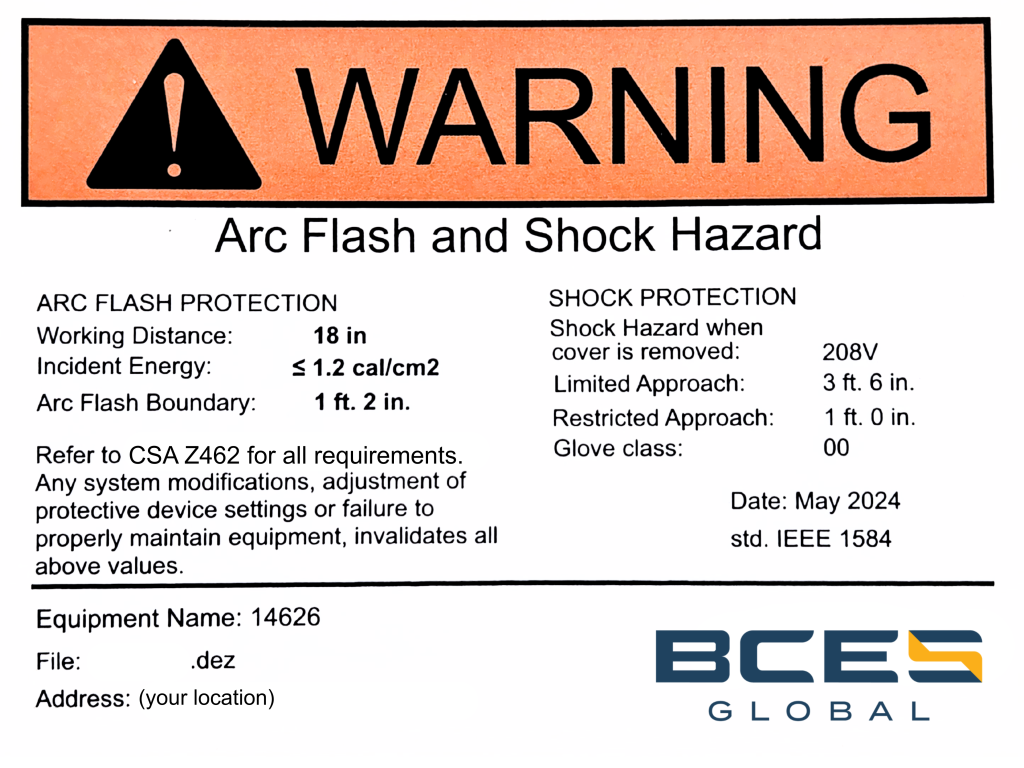
RW Electric provides a complete arc flash study deliverable package including a detailed engineering report, updated single line diagrams, incident energy calculations for each piece of equipment, arc flash boundary determinations, PPE requirement classifications, and arc flash labels for installation on all assessed equipment. The report gives your team the information needed to work safely on your electrical system and demonstrates compliance with CSA Z462.
What is the difference between a short circuit study and a coordination study?
A short circuit study determines the maximum fault current available at each point in your electrical system, ensuring all protective devices are rated to safely interrupt those currents. A coordination study analyzes the time-current characteristics of your protective devices — breakers, fuses, and relays — to ensure they operate in the correct sequence during a fault, isolating only the affected portion of the system while keeping the rest in service. Both studies are typically performed together as they use the same system model and data.
How often should these studies be updated?
CSA Z462 recommends that arc flash studies be reviewed and updated whenever significant changes are made to the electrical system — such as adding or removing equipment, changing utility service, or modifying protective device settings. As a general best practice, studies should be reviewed at least every five years. RW Electric can assess whether your existing study is current or requires updating.
What information does RW Electric need to perform these studies?
RW Electric’s engineers will work with you to gather the information needed to build an accurate model of your electrical system. This typically includes single line diagrams, equipment nameplate data, protective device settings, utility fault current data, and cable and conductor information. Where existing documentation is incomplete or outdated, RW Electric can perform a field survey to collect the necessary data.
Where does RW Electric provide short circuit, coordination, and arc flash study services?
RW Electric: A Division of KROON provides these engineering studies throughout Kingston and Eastern Ontario, and through the BCES Global network of subsidiary companies, across the rest of North America.
How do I arrange a short circuit, coordination, and arc flash study with RW Electric?
Contact RW Electric at 613-634-2341 or through the request form at rwelectric.com. Our engineering team will assess your facility’s electrical system and provide a scoped proposal for a complete study and labeling program.